

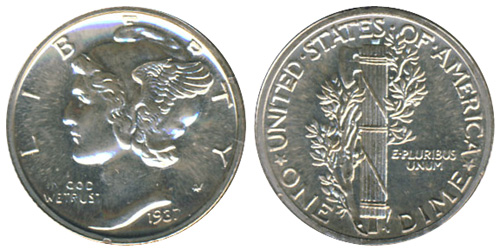
The Philadelphia Mint struck Proof Mercury Dime (Buy on eBay) for a short period of seven years from 1936 to 1942. Mintage levels were fairly high when compared to the previous Proof coin issues of the late 19th and early 20th-century, but low when compared to the later Proof coinage of the 1950’s and beyond.
Lowest Minted Proof
The 1936 Proof Mercury Dime was the first and lowest mintage Proof release with 4,130 pieces struck. The coin is considered to be the key date for a collection of Proofs and commands a premium. Mintage levels climbed for each subsequent Proof release, culminating with the peak mintage of 22,329 pieces for the 1942 Proof Mercury Dime. After this date, Proof coin production was halted as a result of World War II and would not resume until 1950. By this time, the Mercury Dime series had already concluded.
At the time of original release, the seven Proof Mercury Dimes were offered individually priced at 20 cents each, or as part of a complete Proof Set containing one example of each denomination priced at $1.89. Since these coins were saved by collectors and dealers from the time of issue, they remain readily available for present day collectors. Examples in extremely high grades or which exhibit cameo contrast are in greater demand and command premiums.
Proof Mercury Dime Mintages
| Issue | Mintage |
|---|---|
| 1936 | 4,130 |
| 1937 | 5,756 |
| 1938 | 8,728 |
| 1939 | 9,321 |
| 1940 | 11,827 |
| 1941 | 16,557 |
| 1942 | 22,329 |
